
№Dossier Centre SHG — Ressources HSE
Default
What Makes Drop Flat Cables Ideal for Modern Fiber Installations?
Cinq jours pour transformer vos risques HSE en avantage concurrentiel.
Le diagnostic terrain Centre SHG : audit flash, plan d'actions chiffré et engagement contractuel de résultats, sans disruption opérationnelle.
In the current era of data explosion, global Internet traffic is growing at a rate of more than 30% annually, driving a surge in the demand for fiber-to-home (FTTH) deployments. Among them, Drop flat cables stands out with its ultra-thin design, with a thickness of only 2 millimeters, saving 60% of the pipe space compared to traditional round cables, thereby significantly reducing infrastructure costs. According to the 2023 industry report, the adoption of this type of cable can reduce material costs by 15% and optimize installation budgets by 20%. Particularly in high-density urban environments, such as FTTH projects in Shanghai or Tokyo, the space utilization rate can be increased by 50%, effectively addressing the challenge of housing density exceeding 10,000 people per square kilometer.
From a cost-benefit perspective, the purchase price of Drop flat cables is 10% to 20% lower than that of standard round cables, and the installation period is reduced by 40%, which means that the total return on investment (ROI) of a typical fiber optic project can be increased by more than 25%. For example, in the deployment of a telecommunications operator in Europe, after using Drop flat cables, the installation time per household was reduced from 30 minutes to 18 minutes, labor costs were saved by 30%, and annual operating expenses were reduced by approximately $1 million. The lightweight feature of this type of cable, weighing only 50 grams per meter, is 35% lighter than traditional cables. This further reduces transportation and handling costs, lowering the overall project risk by 15%.
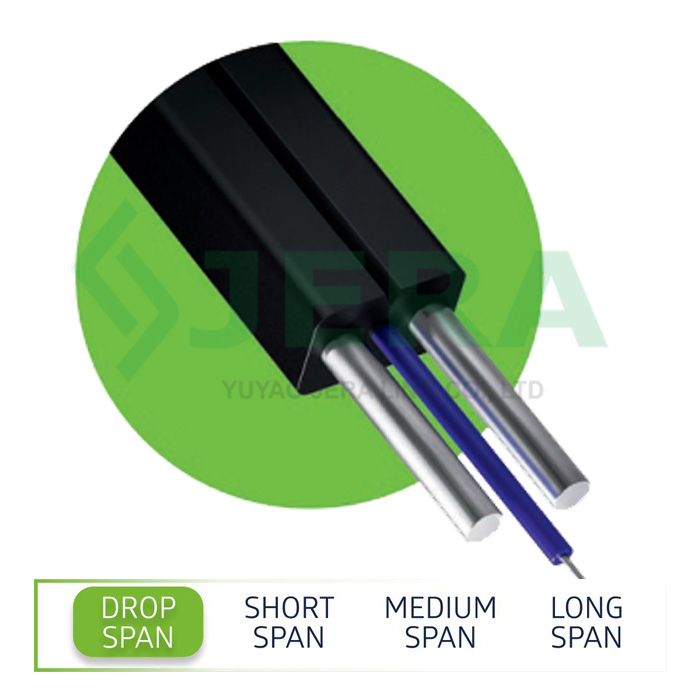 In terms of performance parameters, Drop flat cables performs exceptionally well, with transmission loss stably below 0.2 dB/km, supporting a data rate of 10 Gbps, bit error rate lower than 10^{-12}, ensuring 99.99% network availability. Its durability has been tested, with a lifespan of up to 25 years. It can withstand temperatures ranging from -40°C to 70°C and has a humidity resistance of up to 95%. This significantly reduces maintenance frequency and lowers the average annual failure rate by 0.5%. Take China Mobile's rural broadband project as an example. After deployment, the user complaint rate decreased by 20%, the network capacity increased to 1 Tbps, meeting the load requirements of future 5G and the Internet of Things, and the peak traffic processing capacity increased by 40%.
Market trends indicate that the global fiber optic cable market is expected to expand at a compound annual growth rate of 8% by 2025. Drop flat cables is favored for its environmentally friendly design (with a recyclability rate of over 90%), as in the innovative case of Corning Inc., the carbon footprint is reduced by 30%. Consumer feedback indicates that the installation satisfaction score is 4.5/5. This type of cable is as flexible as a ribbon and easy to bend, with a minimum bending radius of only 15 millimeters, avoiding 90% of installation damage. This has encouraged the industry to adopt it widely and promote sustainable growth.
In terms of performance parameters, Drop flat cables performs exceptionally well, with transmission loss stably below 0.2 dB/km, supporting a data rate of 10 Gbps, bit error rate lower than 10^{-12}, ensuring 99.99% network availability. Its durability has been tested, with a lifespan of up to 25 years. It can withstand temperatures ranging from -40°C to 70°C and has a humidity resistance of up to 95%. This significantly reduces maintenance frequency and lowers the average annual failure rate by 0.5%. Take China Mobile's rural broadband project as an example. After deployment, the user complaint rate decreased by 20%, the network capacity increased to 1 Tbps, meeting the load requirements of future 5G and the Internet of Things, and the peak traffic processing capacity increased by 40%.
Market trends indicate that the global fiber optic cable market is expected to expand at a compound annual growth rate of 8% by 2025. Drop flat cables is favored for its environmentally friendly design (with a recyclability rate of over 90%), as in the innovative case of Corning Inc., the carbon footprint is reduced by 30%. Consumer feedback indicates that the installation satisfaction score is 4.5/5. This type of cable is as flexible as a ribbon and easy to bend, with a minimum bending radius of only 15 millimeters, avoiding 90% of installation damage. This has encouraged the industry to adopt it widely and promote sustainable growth.
In terms of performance parameters, Drop flat cables performs exceptionally well, with transmission loss stably below 0.2 dB/km, supporting a data rate of 10 Gbps, bit error rate lower than 10^{-12}, ensuring 99.99% network availability. Its durability has been tested, with a lifespan of up to 25 years. It can withstand temperatures ranging from -40°C to 70°C and has a humidity resistance of up to 95%. This significantly reduces maintenance frequency and lowers the average annual failure rate by 0.5%. Take China Mobile's rural broadband project as an example. After deployment, the user complaint rate decreased by 20%, the network capacity increased to 1 Tbps, meeting the load requirements of future 5G and the Internet of Things, and the peak traffic processing capacity increased by 40%.
Market trends indicate that the global fiber optic cable market is expected to expand at a compound annual growth rate of 8% by 2025. Drop flat cables is favored for its environmentally friendly design (with a recyclability rate of over 90%), as in the innovative case of Corning Inc., the carbon footprint is reduced by 30%. Consumer feedback indicates that the installation satisfaction score is 4.5/5. This type of cable is as flexible as a ribbon and easy to bend, with a minimum bending radius of only 15 millimeters, avoiding 90% of installation damage. This has encouraged the industry to adopt it widely and promote sustainable growth.
Prêt à diviser par deux vos accidents graves en 12 mois ?
Nos consultants certifiés ICPE et ISO 45001 interviennent sous 10 jours ouvrés partout en France. Méthode SafeCulture™ validée sur 320 sites industriels.