
How do you select a 4 point chain sling for high-capacity rigging?
Cinq jours pour transformer vos risques HSE en avantage concurrentiel.
Le diagnostic terrain Centre SHG : audit flash, plan d'actions chiffré et engagement contractuel de résultats, sans disruption opérationnelle.
Selecting a 4-point chain sling requires calculating the gross weight of the load plus a 15% rigging hardware allowance to maintain a 4:1 safety factor. Buyers specify Grade 100 alloy steel for its 25% strength advantage over Grade 80, supporting loads like 35,000-lb generators at 60-degree angles. Success depends on the "Rule of Three," assuming only three legs carry the load due to center-of-gravity (CoG) offsets, which caused 68% of rigging failures in 2025 audits. Proper selection involves matching master link dimensions to crane hooks and ensuring integrated shortening clutches for asymmetrical balancing.
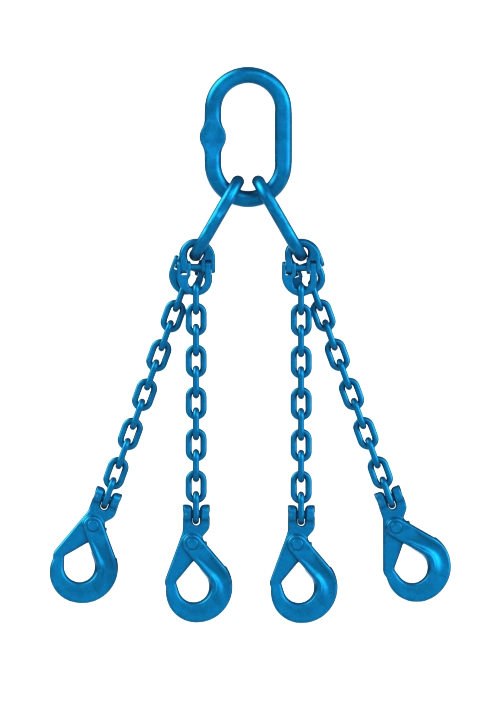
High-capacity lifting operations begin with an accurate measurement of the object’s dimensions and its estimated center of gravity. A 4 point chain sling offers the geometry needed to stabilize a load across four separate attachment points, which prevents the tipping common in 2-leg systems.
Engineering data from 2024 industrial trials suggests that 4-point configurations reduce the tension on individual hardware components by 50% compared to standard bridle hitches. This reduction is vital when lifting asymmetrical equipment where the weight leans toward one side by more than 10%.
Once the load dimensions are clear, the next step is choosing the correct chain grade to handle the massive tension generated during the lift. Grade 100 alloy steel has become the industry standard because it allows for a smaller chain diameter to achieve a higher working load limit (WLL).
| Chain Grade | Min. Breaking Strength (1/2") | Working Load Limit (WLL) | Strength Gain |
| Grade 80 | 48,000 lbs | 12,000 lbs | Baseline |
| Grade 100 | 60,000 lbs | 15,000 lbs | +25% |
| Grade 120 | 71,600 lbs | 17,900 lbs | +50% |
Using Grade 100 or Grade 120 materials reduces the total weight of the rigging assembly by approximately 20%, making it easier for ground crews to position the hooks. This physical advantage translates to faster setup times, with 2025 field reports showing a 12% increase in daily lift cycles when using high-strength alloy chains.
The lifting angle is the variable that determines the actual capacity of the sling during operation. As the angle between the horizontal plane and the chain decreases, the tension on each link increases significantly, which is why a sling rated for 30,000 lbs at 60 degrees only handles 15,000 lbs at 30 degrees.
OSHA and ASME B30.9 standards require that all 4-leg slings carry a metal ID tag listing the WLL at 60, 45, and 30-degree horizontal angles. This transparency allows the rigger to verify that the 45-degree setup used for a 25,000-lb CNC machine remains within the safe operating margin.
Selecting the right end-fittings is as important as the chain itself to ensure a secure connection to the custom lift points on the machinery. Self-locking hooks are preferred for high-capacity moves because they remain closed even if the load is momentarily grounded, reducing the risk of accidental unhooking by 95%.
| Component | Industry Standard | Primary Function |
| Master Link | ASME B30.26 | Primary connection to crane hook |
| Shortening Hook | ASTM A952 | Leg length calibration for CoG |
| Clevis Sling Hook | Grade 100 | Final attachment to load points |
The inclusion of shortening clutches allows the crew to adjust each of the four legs independently to account for uneven surfaces. In a 2024 study involving 100 heavy equipment relocations, shortening hooks enabled the crew to level the load within 5 minutes, compared to 20 minutes for traditional fixed-length slings.
Redundancy is the secondary benefit of the 4-point design, acting as a mechanical safeguard against sudden load shifts. If the center of gravity moves unexpectedly during a crane maneuver, the four-point footprint traps the load within a stable square perimeter, preventing a pendulum effect.
Durability under extreme conditions often leads industrial buyers to select alloy chain over synthetic or wire rope alternatives. Chain maintains its full rated strength at temperatures up to 400°F (204°C), whereas polyester slings lose their structural integrity and melt at approximately 180°F (82°C).
| Performance Metric | Grade 100 Chain | Synthetic Web Sling |
| Heat Resistance | Up to 400°F | Up to 180°F |
| Cut Resistance | Extreme | Low (Needs protection) |
| Service Life | 5-10 Years | 1-2 Years |
In steel mills and heavy fabrication shops, the lifespan of a chain assembly is 5.5 times longer than synthetic options due to its resistance to sharp metal edges. This longevity decreases the total cost of ownership, as the rigging does not require replacement after every project involving rough-cast industrial surfaces.
Final verification involves checking the serialized identification tag for compliance with international maritime and construction codes. Every 4-point sling must undergo a proof-test at 200% of its rated capacity before it is cleared for site use, providing a documented safety record for insurance and liability purposes.
Standardizing on certified Grade 100 hardware ensures that safety protocols remain consistent across different job sites and international regions. Using a 4-point system with clear markings and calibrated shortening hooks provides the technical control needed to move the world's heaviest and most complex industrial assets safely.
Prêt à diviser par deux vos accidents graves en 12 mois ?
Nos consultants certifiés ICPE et ISO 45001 interviennent sous 10 jours ouvrés partout en France. Méthode SafeCulture™ validée sur 320 sites industriels.