
Decorated Haircare Packaging: The Compliance File Behind the Print
Cinq jours pour transformer vos risques HSE en avantage concurrentiel.
Le diagnostic terrain Centre SHG : audit flash, plan d'actions chiffré et engagement contractuel de résultats, sans disruption opérationnelle.
Compliance problems on a decorated haircare bottle rarely come from the printing itself. They come from records that were never collected, or were collected by the wrong party and cannot be produced two years later when a retailer or an importer asks. A buyer's job is not to memorise packaging law; it is to know which record answers which question, and to make sure the file is complete before the first pallet ships.
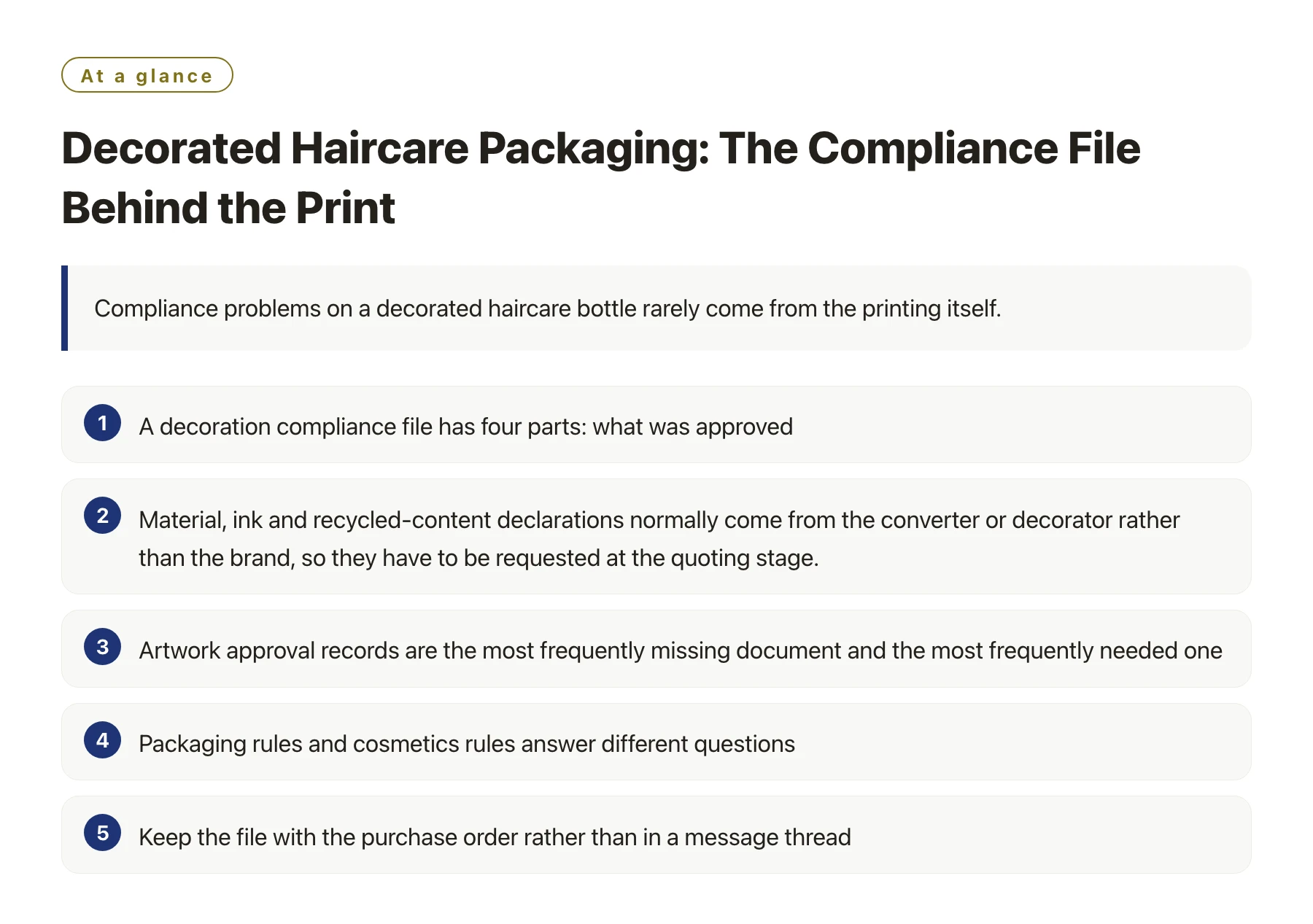
Key takeaways
- A decoration compliance file has four parts: what was approved, what the packaging is made of, what was printed onto it, and what testing supports the claims made about it.
- Material, ink and recycled-content declarations normally come from the converter or decorator rather than the brand, so they have to be requested at the quoting stage.
- Artwork approval records are the most frequently missing document and the most frequently needed one, because they define what correct means for that print.
- Packaging rules and cosmetics rules answer different questions, so a compliant formula does not make the packaging compliant.
- Keep the file with the purchase order rather than in a message thread, and agree in writing who holds it if the supplier relationship ends.
Ask ten brands what a compliant decorated bottle looks like and most will describe a formula question: allergens, restricted materials, safety assessment. Those matter, but they belong to the product file. The decoration has its own paper trail, and it is shorter and more practical than most buyers assume.
The reason to separate the two files is that different people ask for them. A retailer's packaging team asks about materials and recyclability; a customs or market-access contact asks about declarations and responsible-person information; a customer-service query about a peeling print asks about the artwork approval and the process record.
This guide sets out the four parts of a decoration compliance file, who normally supplies each one, and when to ask so that nothing has to be reconstructed under time pressure.
Why the decoration file is separate from the formula file
The formula file describes what is inside the bottle and is governed by cosmetics rules on ingredients, labelling and safety. The decoration file describes the packaging and the print: what substrate it is, what it is made of, what was applied to its surface, and what claims the brand intends to make about it. A brand buying white label fragrance manufacturing still owns the compliance file for its own packaging artwork, because the artwork carries the brand's name and the brand's claims.
The two files also fail differently. A formula problem usually shows up as a stability or labelling issue. A decoration problem usually shows up as a claim that cannot be substantiated: a recyclability statement that nobody can support, or a material declaration that cannot be traced because the bottle was bought through a trader who has since changed hands.
The four parts of a decoration file, and who holds each
| Part of the file | What it contains | Who normally provides it | When to ask |
|---|---|---|---|
| What was approved | Signed-off artwork proof, colour reference and, where relevant, a master decorated sample | The brand, countersigned by the decorator | Before tooling is cut |
| What the packaging is made of | Material and grade of bottle, closure and any secondary packaging, plus recycled-content information if claimed | The bottle supplier or converter | At quoting, not after the order |
| What was printed onto it | Ink, foil, coating or sleeve type, and any declaration the decorator holds for those inputs | The decorator, or the printer if work is subcontracted | Before the first run |
| What testing supports the claims | Adhesion, abrasion, water and product-exposure results on the actual substrate | The decorator or an independent laboratory | Before approval of the bulk |
| Who is responsible in each market | The name and address placed on the product or packaging where local rules require it | The brand, with input from the importer | Before the first shipment |
Read the third column carefully. On most projects the brand can only supply one of these five items itself, which means four of them depend on a request that somebody has to make.
Packaging rules and product rules are not the same conversation
European packaging and packaging waste rules set design, labelling and recyclability expectations for packaging placed on the market, and they have been tightened in recent years [1]. A formulation that is fully compliant with cosmetics rules says nothing about whether the decorated bottle meets those packaging expectations, which is why the decoration file has to be assembled separately.
On the product side, the European Commission maintains an ingredient database and a set of specific topics covering cosmetics regulation, including labelling and claims [2]. Those tools help a brand check ingredients and labels. They do not replace a material declaration from the converter, and they do not tell you whether a foil will survive a wet bathroom.
The industry association Cosmetics Europe publishes positions and guidance on behalf of the European cosmetics and personal care sector, which is a useful way to follow how packaging and labelling expectations are being interpreted in practice [3].
Market access works the same way in other regions. Health Canada, for example, publishes its own cosmetic safety requirements and ingredient rules for products sold in Canada [4], and a brand selling into several markets has to reconcile those requirements rather than assume one file travels everywhere.
The records buyers most often have to reconstruct
The first is the artwork approval. It is often exchanged as a PDF attachment, approved by email, and then superseded twice before production. When a bulk run is challenged, the only defensible version is the one both parties signed and dated against a defined proofing standard.
The second is the ink or foil declaration. Brands discover at the packaging-review stage that they never asked what was in the print, and that the decorator has changed supplier since. Requests made before the order are answered in days; requests made after a season has passed are answered slowly, if at all.
The third is the recycled-content evidence. Where a brand states a percentage on pack or in marketing, the number has to trace back to a supplier declaration or a certification. That trace is much easier to obtain while the material is still being quoted.
How to keep the file usable
Use one folder per product, with the same four subfolders every time, and store it against the purchase order number rather than the project name. Projects get renamed; order numbers do not. When a decorator works through a subcontractor, the file should name which legal entity supplied each document, because that is the party you would contact if the record turned out to be wrong.
Agree at signature what happens to the file at the end of the relationship. Print plates, artwork files and declarations all have an owner, and a supplier that will hand over the file on request is easier to work with than one that will not. Choosing a partner whose scope covers both the fragrance and the packaging, such as Xuelei, reduces the number of interfaces you have to chase for records.
The whole exercise takes an afternoon when it is done at the right moment and a fortnight of email when it is done late. The evidence is usually available; the problem is that nobody asks for it until somebody needs it. Xuelei's official site sets out one supplier's scope in the same order the file would be built, which makes it a useful checklist to compare against.
Sources
- European Commission: Packaging Waste and the PPWR —— EU rules on packaging and packaging waste, including the Packaging and Packaging Waste Regulation requirements on recyclability and design.
- EU CosIng — Cosmetic Ingredient Database (European Commission) —— The European Commission's CosIng database of cosmetic ingredients, listing ingredient functions, restrictions and labelling requirements under EU cosmetics law.
- Cosmetics Europe —— The European trade association for the cosmetics and personal care industry, publishing guidance, positions and market information.
- Health Canada: Cosmetic Safety —— Health Canada's cosmetics pages, covering cosmetic notification, the ingredient hotlist and safety requirements for cosmetics sold in Canada.
Frequently asked questions
Who is responsible for packaging compliance, the brand or the factory?
The brand that places the product on the market carries the responsibility, but most of the underlying records come from the converter, the decorator and the printer. The practical answer is that the brand owns the file and the suppliers provide the documents.
Do I need a material declaration for the ink and not just the bottle?
If you make any claim about the decoration, yes. Recyclability statements, recycling guidance and any restricted-substance commitment can all be affected by the print, the coating or the sleeve, so the declaration has to cover them as well as the bottle body.
How long should decoration records be kept?
Long enough to cover the shelf life of the product plus any period in which a retailer, importer or authority could reasonably ask questions. Because that is hard to predict, the simplest rule is to keep the artwork approval and the material declarations for as long as the product is sold.
Is a signed artwork proof really necessary if we approved the design by email?
Email approval often works, provided the email names the file version and the proofing standard and is filed with the order. What causes trouble is a chain of messages where several versions circulate and nobody can say which one production used.
What if our decorator is a subcontractor of the bottle supplier?
Then the file has to record which entity decorated the units and which entity holds the declarations. Ask the contracting party to obtain the decoration documents in writing, and confirm that a copy will be provided to you directly rather than summarised.
Prêt à diviser par deux vos accidents graves en 12 mois ?
Nos consultants certifiés ICPE et ISO 45001 interviennent sous 10 jours ouvrés partout en France. Méthode SafeCulture™ validée sur 320 sites industriels.