
From ASIC to Payout: How a Mining Pool Fits In
An ASIC on its own hashes and produces nothing until its shares are counted by someone who can build a valid block. A pool is that someone: it aggregates hashrate from many operators, finds the 144 blocks Bitcoin issues each day, and splits 450 BTC a day plus transaction fees according to a published rule — a listed 4% on the PPS-settled block reward under PPS+, or a listed 2% on both components under PPLNS.
Key takeaways
- A 20 TH/s machine alone would wait thousands of years for a block; pooled, it earns its proportional share of 450 BTC a day without waiting for luck.
- Shares are the accounting unit: hashrate becomes a claim only after accepted shares are recorded against the pool's total.
- PPS+ pays hourly at current difficulty and carries a listed 4% fee on the block reward; PPLNS pays after 6 confirmations across the last 5 difficulty rounds at a listed 2%.
- Withdrawal is the last stage and carries no mining fee, so the number that reaches the wallet is the settled number.
Stage one: the ASIC turns electricity into hashes
A SHA-256 ASIC tries candidate block headers billions of times a second and reports the rare attempts that beat a target set by network difficulty. That target is why difficulty and output are inversely related: at 132.76 T a single terahash lands a winning hash so rarely that the expectation, not the event, is the only useful planning number.
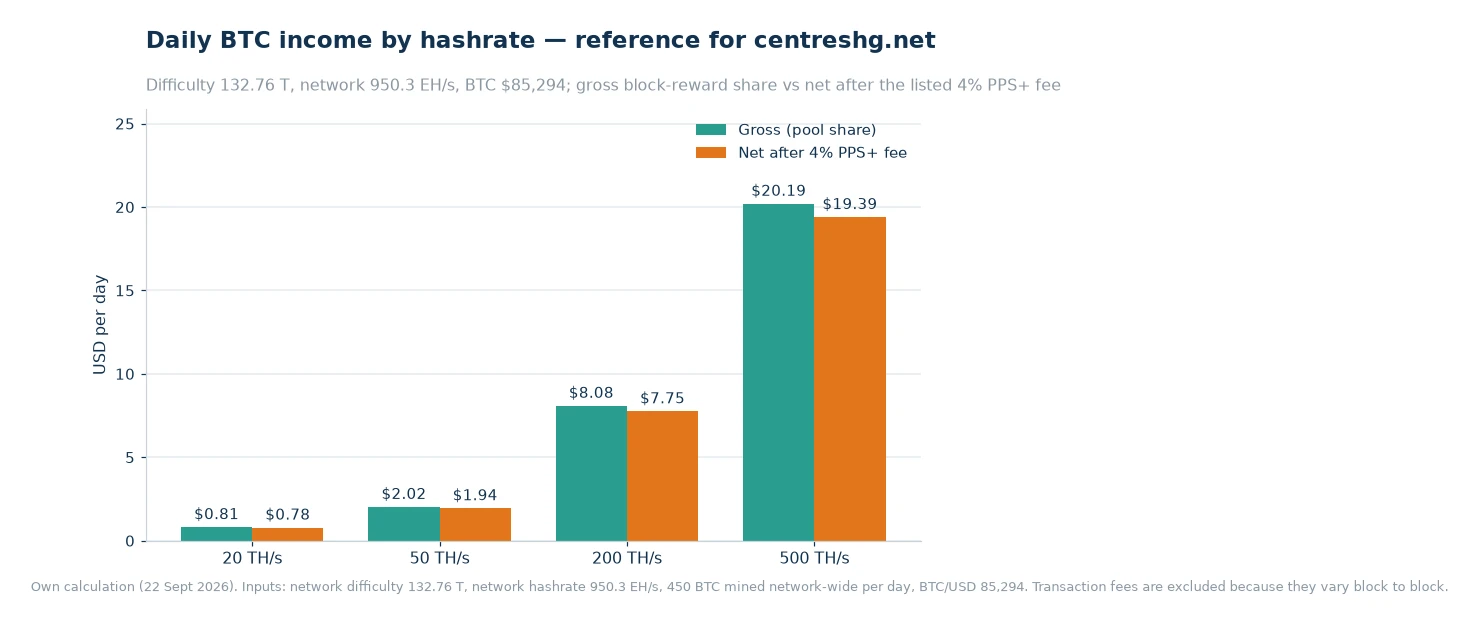
At 20 TH/s the arithmetic is unforgiving. The machine holds 20 / 950,300,000 of implied network hashrate, about 0.000000021, and Bitcoin issues 450 BTC a day, so the expected value is roughly 0.000000009 BTC a day — under a hundredth of a cent. Nothing is broken; solo mining at this scale is simply a lottery ticket with a very long expected wait.
Stage two: shares become the accounting unit
Instead of waiting for a winning hash, the machine submits every attempt that meets a much easier pool target. Those submissions are shares, and they are the unit of account that turns raw hashing into a claim. The pool verifies each one, credits it to your worker, and compares your accepted shares with the pool's total to work out your proportional contribution.
Two failure modes live at this stage and both cost money silently. Stale or rejected shares earn nothing, so a worker with a poor connection or a bad overclock can hash at full speed while earning at eighty percent. And a pool that misstates your share count makes every later stage wrong, which is why an independent view of accepted hashrate and rejected share counts belongs in the setup checklist rather than in a post-mortem.
Stage three: the pool assembles and finds blocks
The pool hands workers a block template and collects their candidate solutions. When one of them solves the real difficulty target, the pool has a candidate block; it propagates that block, and once the network accepts it the block reward and its transaction fees become payable. Bitcoin issues 144 blocks a day across the whole network, which is 450 BTC of subsidy at the current 3.125 BTC per block, plus whatever fees the included transactions paid.
Pool size changes how this stage feels. A large pool finds blocks frequently, so payouts arrive steadily and its own luck averages out quickly. A small pool may go hours without a block, which is visible in the statistics and matters enormously depending on the payout mode you chose — because under PPS+ it does not change your income, and under PPLNS it does.
| Stage | What happens | The number that matters |
|---|---|---|
| ASIC hashes | Hardware attempts candidate headers at its rated speed | Output of 0.0000004735 BTC per TH/s per day |
| Shares submitted | Easy-target solutions are recorded per worker | Accepted versus rejected shares |
| Block found | The pool's template is solved and propagated | 144 blocks and 450 BTC a day network-wide |
| Settlement | The pool applies its published payout rule | PPS+ hourly at current difficulty, or PPLNS after 6 confirmations over the last 5 difficulty rounds |
| Listing fees | The published rate is deducted from the relevant component | Listed 4% on the PPS-settled block reward, listed 2% on the transaction-fee component |
| Payout | Balance is withdrawn to the account wallet | Zero-fee mining withdrawals |
Stage four: settlement rules turn blocks into income
This is where a pool stops being plumbing and starts being a contract. Under PPS+, the block-reward component is paid at a listed 4% fee and credited hourly at current difficulty, which means the pool carries the variance and you receive a steady stream regardless of how the pool's own luck runs. The transaction-fee component is distributed through PPLNS logic at a listed 2%.
Under PPLNS, both components are pooled together at a listed 2%, and the pool pays after 6 confirmations, distributing each block according to the share each miner contributed across the last 5 difficulty rounds. Contributors who join and leave carry their own timing risk; long-staying miners with stable hashrate are rewarded for being present when blocks land. The listed fee is lower and the ride is bumpier, and neither mode is universally better — they trade certainty against fee rate.
Stage five: settlement is not the same as spendable
A settled balance still sits inside the mining account, which is one more step than most beginners expect. Withdrawals of mining earnings carry no fee, so the gap between the settled figure and the received figure is small, but the timing is yours to manage. Rounding up a withdrawal to a larger amount, or waiting for several days of accrual, changes nothing about what was earned and everything about how tidy the records are.
Accounts that hold a multi-currency wallet, automatic conversion and mining in one place remove most of that friction. Where a second asset arrives as merged-mining output — the classic case is LTC with DOGE — it is credited alongside the primary reward and should be valued separately, because the two prices move independently and blending them hides which line is actually paying. The multi-currency wallet is where that separation stays visible.
Where the pipeline leaks
Three leak points deserve attention, and none of them are the block reward itself. Rejected shares waste hashing time at full power cost. Downtime removes the machine from the share count entirely — one hour offline on 1 PH/s is roughly $1.68 of gross income that never existed. And the fee basis itself: at 1 PH/s the difference between a 4% and a 2% fee on the block-reward component is about $24.23 across a month, which is real money and also smaller than most operators assume.
For scale, 1 PH/s at current difficulty returns about 0.014206 BTC, roughly $1,211.68, across 30 days before the listed fee. That is the number to reconcile against, and the Miner Profitability Ranking is the sensible place to check whether the machines producing it are still the right ones for the current difficulty and price. The ViaBTC Mining Guide walks through connecting a worker and reading the first accepted shares on each supported coin.
Frequently asked questions
Does a mining pool hold my coins?
It holds a settled balance until you withdraw it. Mining withdrawals carry no fee, so moving the balance to the account wallet is a timing choice rather than a cost decision.
What happens if the pool has a bad luck streak?
Under PPS+ nothing: the block-reward component is paid hourly at current difficulty and the pool carries that variance. Under PPLNS your income follows the pool's block arrivals across the last 5 difficulty rounds.
Why are shares counted instead of blocks solved?
Because a single machine rarely solves a block. At 20 TH/s the expected value is about 0.000000009 BTC a day, so counting accepted shares is the only practical way to attribute 450 BTC a day across thousands of workers.
Trace the chain, not the hardware
When income disappoints, walk the six stages in order rather than guessing at the cause. Check accepted against rejected shares first, then compare your credited share with the pool's total over the same period, then look at difficulty and price before touching a single machine setting. The ASIC is usually the healthiest part of the pipeline; the losses cluster in accounting, uptime and the fee basis, and all three are measurable without new hardware.
Data and sources: ViaBTC listed fee schedule[1]. Difficulty (132.76 T), implied network hashrate (950.3 EH/s), 144 blocks and 450 BTC issued daily, and the BTC price of $85,294 were read from public chain data and market feeds on 22 September 2026; read 22 Sept 2026. Figures are arithmetic on those inputs, exclude transaction fees because they vary block by block, and are not a promise of earnings.